
Why Your Facebook Ads Are Not Generating Leads
By Qkads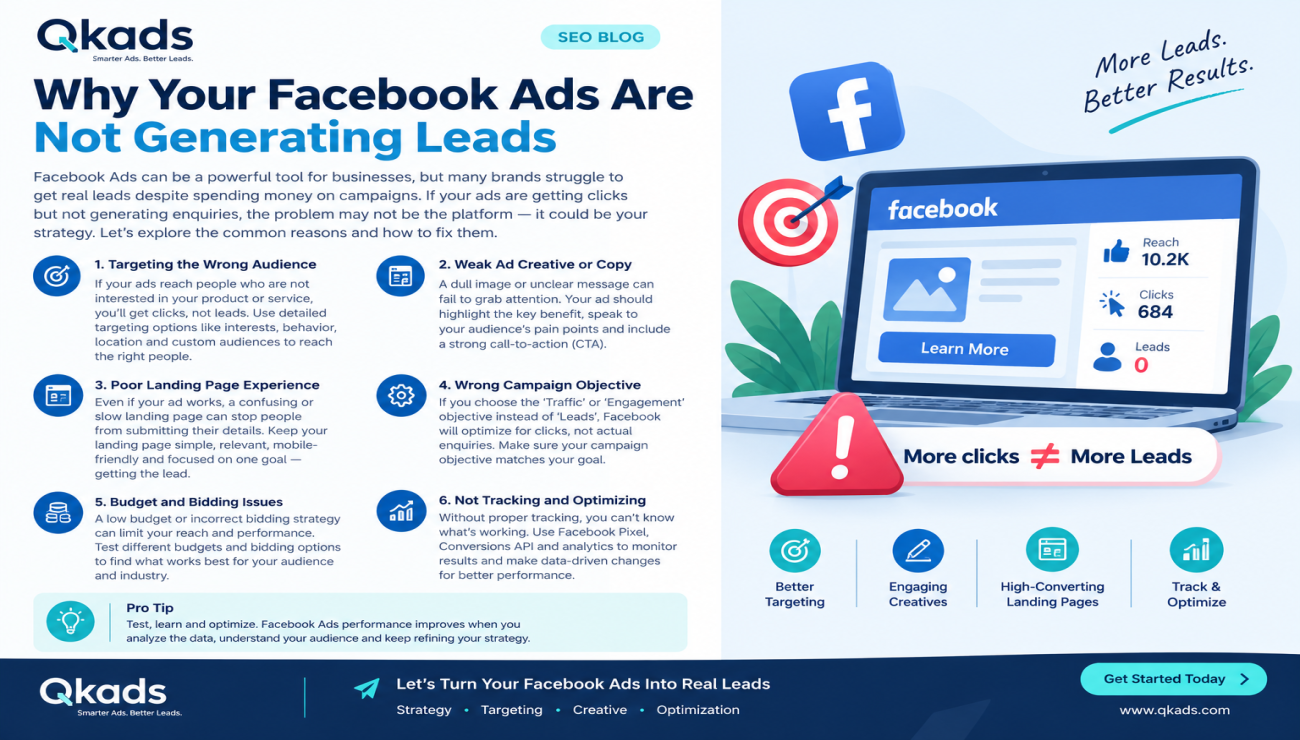
 By Qkads
Why Your Facebook Ads Are Not Generating Leads
Introduction
Facebook advertising is a powerful way for businesses to reach potential customers, promote services, and generate enquiries. However, many businesses invest in Facebook Ads without getting the leads or conversions they expect.
Your ads might receive impressions, clicks, and engagement, but if people are not filling out your forms or contacting your business, something in your campaign strategy may need improvement.
The good news is that poor lead generation does not always mean Facebook Ads are ineffective. The problem could be your audience targeting, ad creative, landing page, campaign objective, budget, or conversion tracking.
At Qkads, we believe that successful online advertising requires more than getting clicks. It requires reaching the right audience and turning their interest into meaningful business opportunities.
Let's explore seven common reasons why your Facebook ads are not generating leads and how you can fix them.
1. You Are Targeting the Wrong Audience
One of the most common reasons Facebook ads fail to generate quality leads is poor audience targeting.
If your advertisements reach people who are not interested in your products or services, you may receive clicks without generating genuine enquiries.
For example, a business offering digital marketing services in Chandigarh may waste money targeting a broad audience across multiple locations without considering its actual service area.
How to fix it
-
Define your ideal customer based on location, needs, interests, and behaviour.
-
Use relevant geographic targeting for local businesses.
-
Test different audience segments instead of relying on one broad audience.
-
Use customer lists and website remarketing audiences where appropriate and permitted.
-
Review lead quality, not just audience reach.
Pro tip: Start with a clear customer profile and refine your targeting based on actual campaign results.
2. Your Ad Creatives and Copy Are Not Compelling
Your ad creative is often the first thing a potential customer notices. If your image, video, or message does not communicate a clear benefit, people may scroll past without taking action.
Generic headlines, cluttered designs, unclear offers, and weak calls to action can reduce engagement and conversions.
How to fix it
Create advertisements that clearly explain what you offer and why it matters to your audience.
-
Use clear, high-quality images or short videos.
-
Write attention-grabbing but relevant headlines.
-
Highlight a specific customer problem and your solution.
-
Include a clear call to action, such as “Get a Free Quote” or “Contact Us.”
-
Test different creatives and messages to identify what works best.
Your advertisement should make the next step easy to understand without making unrealistic promises.
3. Your Landing Page Is Not Converting Visitors
Getting clicks is only half the job. If your advertisement sends visitors to a confusing, slow, or irrelevant landing page, many may leave without contacting you.
A landing page that does not match the promise made in your ad can also create uncertainty and reduce trust.
How to fix it
Make sure your landing page:
-
Loads quickly on mobile devices.
-
Matches the message and offer in your advertisement.
-
Clearly explains your service and its benefits.
-
Includes a visible enquiry form or contact button.
-
Displays genuine testimonials or trust signals where available.
-
Requests only the information needed to follow up.
If you use Facebook Instant Forms, keep the form relevant and easy to complete. Consider additional qualifying questions when lead quality matters more than raw volume.
4. You Are Using the Wrong Campaign Objective
Facebook advertising campaigns can serve different purposes, including awareness, traffic, engagement, and lead generation.
If your main goal is to collect enquiries but your campaign is optimized primarily for traffic or engagement, the results may not align with your business objectives.
How to fix it
Choose the campaign objective that matches your desired outcome.
For lead generation, consider suitable lead-focused campaigns using Instant Forms, website forms, calls, or messaging, depending on your business needs and available campaign options.
Set up conversion tracking correctly and ensure your campaign's optimization event reflects the action you actually want customers to take.
Remember that selecting the right objective helps guide delivery, but it does not guarantee leads. Your offer, creative, audience, and conversion experience still matter.
5. Your Budget and Testing Strategy Need Improvement
A limited budget, an overly fragmented campaign structure, or frequent changes can make it difficult to understand what is working.
At the same time, spending more money on a poorly performing campaign will not automatically improve lead generation.
How to fix it
-
Start with a realistic budget based on your business goals and market.
-
Test a small number of meaningful audience and creative variations.
-
Allow enough time and data for a fair evaluation.
-
Avoid making major changes based on very limited results.
-
Increase spending gradually when campaigns demonstrate consistent performance.
Monitor cost per lead alongside lead quality and sales outcomes. The cheapest lead is not necessarily the most valuable lead.
6. You Are Not Tracking Conversions Properly
Without accurate tracking, you may know how many people clicked your ads but not how many became genuine prospects or customers.
This makes it difficult to compare campaigns and allocate your budget effectively.
How to fix it
Use relevant measurement tools, such as Meta Pixel, Conversions API, website analytics, and CRM records, where appropriate.
Track meaningful actions, including:
-
Completed lead forms.
-
Qualified enquiries.
-
Calls or appointments generated by campaigns.
-
Leads that progress into sales opportunities.
-
Customers acquired through advertising.
Check that conversion events are configured correctly and that reporting avoids duplicate or misleading counts.
7. You Are Not Following Up With Leads Quickly
Sometimes Facebook Ads generate enquiries, but businesses still struggle to convert them into customers because the follow-up process is inconsistent.
A delayed response, unanswered phone call, or generic message can cause potential customers to lose interest.
How to fix it
-
Respond to new enquiries promptly during business hours.
-
Assign responsibility for lead follow-up.
-
Use clear, helpful messages that address the customer's requirements.
-
Record enquiry status and follow-up outcomes.
-
Review which campaigns produce leads that actually convert into sales.
Where appropriate, use email, calls, or WhatsApp with suitable consent and communication preferences.
A good advertising strategy should connect lead generation with an effective sales follow-up process.
How to Improve Your Facebook Ads Lead Generation Strategy
To improve campaign performance, focus on a complete process rather than changing individual ad settings randomly.
Step 1: Define your ideal customer and campaign goal.
Step 2: Create clear ad creatives and a compelling offer.
Step 3: Select the appropriate campaign objective and conversion destination.
Step 4: Test relevant audiences, messages, and creative variations.
Step 5: Check tracking and measure qualified leads.
Step 6: Follow up consistently and review the leads that become customers.
Step 7: Optimize campaigns using real performance data.
This structured approach can help you identify weaknesses, reduce wasted spending, and make better advertising decisions over time.
Why Choose Qkads for Digital Advertising?
Running effective Facebook Ads requires strategy, creative development, audience research, conversion tracking, and ongoing optimization.
Qkads helps businesses explore digital marketing solutions designed to strengthen their online presence and connect with relevant audiences.
Whether you want to promote your services, improve lead generation, or build a more effective online advertising strategy, focusing on campaign objectives and measurable outcomes is an important step toward sustainable business growth.
Visit Qkads.com to learn more about our digital marketing solutions.
📞 Contact Details
Looking to post a property, product, job, service, or business advertisement?
📱 Contact: 9814102655
📧 Email: rajk6764@gmail.com
🌐 Website: QKAds.com
For listing assistance, advertising enquiries, or more information, feel free to get in touch.
Recent Blog
Testimonials
I was searching for a rental apartment and found the perfect one through QkAds. The filters and categories make it really easy to find exactly what you need.

Sumit Yadav
SellerAs a small business owner, QkAds helped me reach local customers without spending on ads. Posting is free and super fast. Great platform!"

Manish Kumar
SellerI was searching for a rental apartment and found the perfect one through QkAds. The filters and categories make it really easy to find exactly what you need.

Sanjay
WriterQkAds is my go-to platform now. Whether it's selling furniture or finding services, everything is in one place. Simple, fast, and reliable

Kritika
Writer
Comments (0)